I'v recently found myself needing to use a task manager to make some bulk operations (to be more precise, I wanted to copy all of my tasks to a device with no built-in synchronization mechanism for those). I happen to make use of the great Remember The Milk Web application (I've previously worked with Emacs Planner, but I had to drop it in favor of a more mobile version of my life).
Enter Common Lisp. Perhaps the fastest way to do some scripting in my mind, but I've yet to make a library to use a Web-based API. Turned out it was quite clean, and in about 5 hours of work I had the whole API grokked, coded, tested and hosted in GoogleCode here. (I looked into cl.net, but found the google's approach to hosting much more featured for the fast start I was looking for. If this has enough momentum I can look into it again, with more time - the main advantage would be asdf-installability, I suppose.)
I already had experience making project "skeletons" (asdf project file, package declaration, etc.). So the hardest thing I had to do was look into the web API call mechanism and into the md5 encryption. If you don't need the detailed description, tha answers are, respectively, Drakma and Ironclad. ( I also use cl-json to parse RTM's responses into a lisp-friendly format.)
To call a Web-based method, we need to make an HTTP request, and be able to read the response. using drakma (asdf installable and loaded in the usual way), all I had to do was something like:
(http-request rtm-api-endpoint :method :post :parameters '(("param-name" . "param-value")))
With some parameter abstractions, RTM's was easily tamed. A call to one of their methods is now made with the following macro:
| (defun rtm-api-call-method (method &optional key-value-pairs &key with-timeline with-authentication (format "json")) "Calls `METHOD'. - Optionally passes pairs of strings in `KEY-VALUE-PAIRS' in the form of (`PARAMETER' . `VALUE'). - Keyword `WITH-TIMELINE', if not null, allows the method to be called within the `*CURRENT-TIMELINE*'. - Keyword `WITH-AUTHENTICATION', if not null, allows the method call to be authenticated with a valid `*RTM-API-TOKEN*'. - Keyword `FORMAT' is one of \"json\" (the default value) or \"rest\", and specifies the server reply format." (declare (special *current-timeline*)) (let* ((parameters `(("api_key" . ,rtm-api-key) ("method" . ,method) ("format" . ,format) ,@(when with-timeline (with-timeline `(("timeline" . ,*current-timeline*)))) ,@(when with-authentication `(("auth_token" . ,*rtm-api-token*))) ,@key-value-pairs)) (api-sig (compute-rtm-api-sig parameters))) (multiple-value-bind (result) (http-request rtm-api-endpoint :method :post :parameters `( ,@parameters ("api_sig" . ,api-sig))) (let* ((response (json-bind (rsp) result rsp)) (stat (assoc :stat response))) (cond ((string= (cdr stat) "ok") (rest response)) ((string= (cdr stat) "fail") (let ((err-info (cdr (assoc :err response)))) (error "RTM error code ~a: ~a~%" (cdr (assoc :code err-info)) (cdr (assoc :msg err-info)))))))))) |
With this (rather big, for the sake of readability, or mayhap due to my lack of experience in mental pretty printing) function, I define a call to an RTM module simply by coding:
| (defun rtm-api-tasks-complete (list-id taskseries-id task-id) (rtm-api-call-method "rtm.tasks.complete" `(("list_id" . ,list-id) ("taskseries_id" . ,taskseries-id) ("task_id" . ,task-id)) :with-authentication t :with-timeline t)) |
The only call in the first function definition that cannot be easily guessed how they work is the compute-rpm-api-sig-parameters. This is the function that performs the algorithm required by RTM to encode all parameters and guarantee authenticity in each request (along with a masked API key). Basically it does some mambo-jumbo concatenation with each parameter's name and value, and then performs an MD5 to get the equivalent hash code. Easy, right? But I'm a lazy programmer. That, and I truly believe there's no point in reinventing the wheel, so I looked for encryption functions in Lisp, and I found Ironclad, a collection of most of these functions in Lisp. So producing an md5 functions was as easy as the following:
| (defun md5 (string) "MD5 uses ironclad to encode `STRING' into an hexadecimal digest string." (ironclad:byte-array-to-hex-string (ironclad:digest-sequence :md5 (ironclad:ascii-string-to-byte-array string)))) |
And that's about it. The rest was toying around, the API works perfectly (kudos to the RTM dev team!), and I was thrilled to have my tasks exported in a jiffy. If you want to find more info, feel free to snoop through the code (it's quite easy to grasp, I think, and relatively small), in the Google Code site: http://code.google.com/p/rtm-lisp-api/ . So now, what would you, gentle reader, do with this API? Drop me some comments with your ideas.
Until the next time!


.gif)
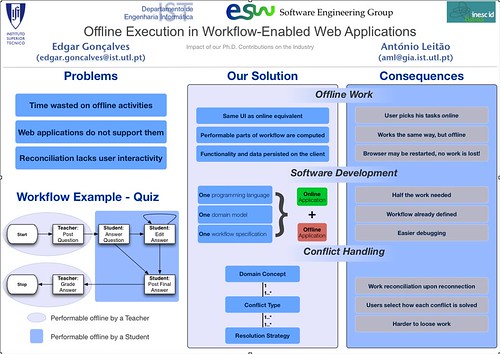
 As I depict in the preceding diagram, after the client knows the code to the computation he needs to finish, it can gain the ability to perform it without accessing the server (unless there is some server-side information that needs to be fetched, obviously).
 As one can see, this may pose other challenges, such as domain data access control (e.g., I may not be able to have full control to some objects that were being used by the server to produce the interface, and thus I cannot have that (whole) object on the client side).
 In the "several interactions" arrows can be two main types of communication. There can be only data exchange, like in instant messaging, white-boards or on-line games. But there may also be execution flow exchange. You can have two clients making parallel computations, in a sort of collaborative processing. You can also have ubiquitous execution, like having a smart-phone "pick up" the application execution from the desktop computer's browser and carrying on with it.